Assisted critical thinking: use AI as an internal challenger, not an oracle 🧪

Have you ever read a polished AI answer, clean and almost elegant, and thought, “Perfect, let’s do this”? Then two days later the first production incident lands, and you realize that solution was like a freshly painted facade: impressive from afar, fragile up close.
The issue is not that AI “gets things wrong.” We get things wrong when we treat it like an oracle instead of an internal challenger. The whole difference is there: in the first case we delegate judgment, in the second we train it.
The most useful AI is not the one that answers for you, but the one that improves the quality of your doubts before they become bugs.
Plausible answers, risky decisions 🎭
In daily work there is a powerful temptation: confusing linguistic plausibility with technical reliability. A well-written output reassures us. And reassurance, in software, is often the most elegant name for a shortcut.
When we accept an AI proposal without challenge, we are not accelerating knowledge: we are automating confirmation bias. If the team is already leaning in one direction, the model will often reinforce it with coherent arguments. Coherent, yes. Necessarily true, no.
It is the same pattern highlighted in Question-Driven Specification: the problem is not producing answers quickly, but deciding well while requirements are still opaque.
From oracle to internal challenger 🪞
The “oracle” model is easy to describe: ask, receive, paste, merge. It is also the most dangerous one, because it removes friction exactly where friction is needed.
The “challenger” model follows a different logic: ask, stress-test, compare, decide. AI is not the final judge; it is the counterpart that forces you to make assumptions, limits, and trade-offs explicit.
In practice, it changes your mental stance. You stop asking “what is the right solution?” and start asking “where can this solution break?” That single inversion prevents expensive surprises.
Accepting AI output without challenge is not efficiency: it is haste with good grammar.
The C-C-C-D protocol to avoid self-deception 📐
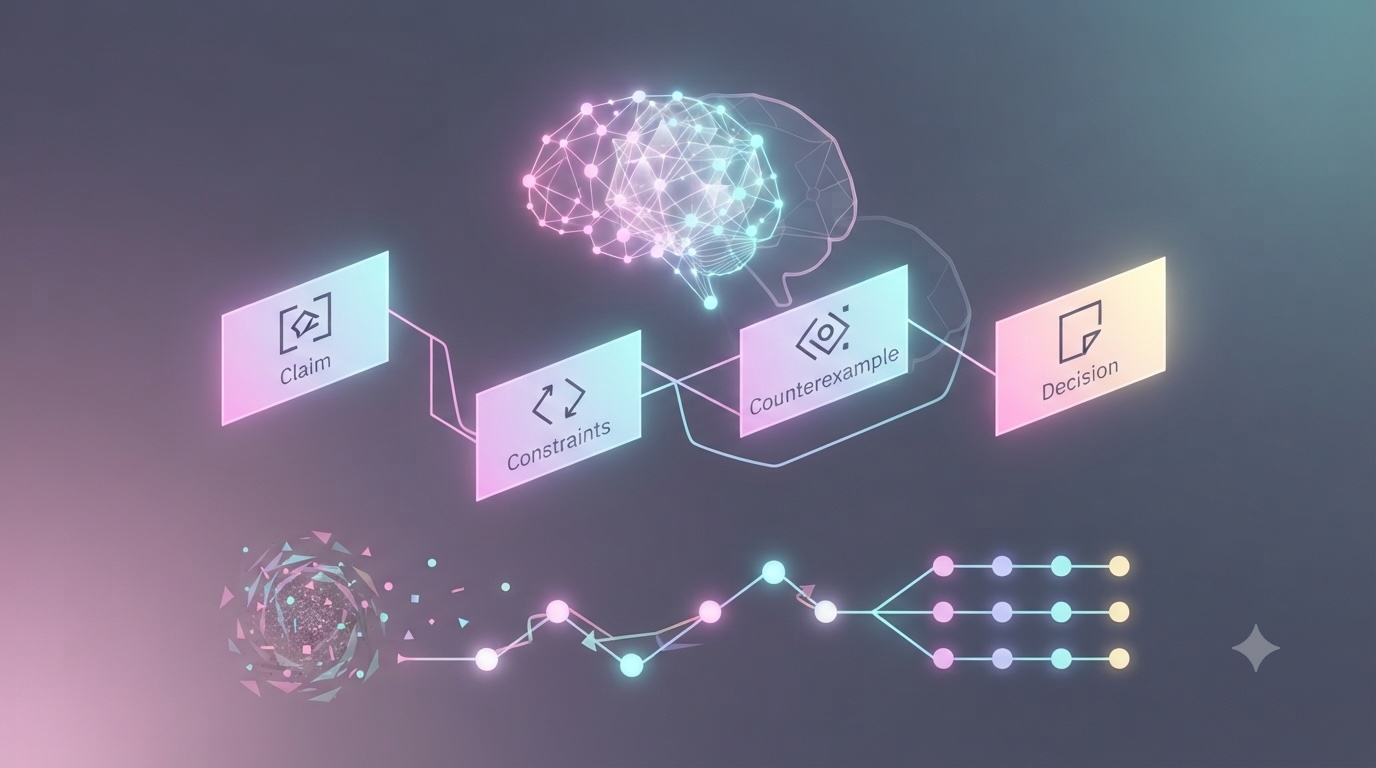
When a decision has real impact, I use a minimal four-step protocol:
- Claim: what is the model actually asserting?
- Constraints: which real-world constraints must hold in your context? Security, performance, compliance, operating costs, legacy compatibility.
- Counterexample: what concrete case makes this proposal fail?
- Decision: what do you accept, what do you reject, what do you validate with tests before merge?
It looks simple. It works because it forces teams to stop arguing from impressions and start arguing from falsifiability. In other words: fewer free-floating opinions, more testable hypotheses.
If you want a complementary foundation, the mindset in Unknowns-Driven Development fits perfectly: start from what you do not know, instead of pretending premature clarity.
Prompts that improve critique, not only output ✍️
Many prompts ask for output. The most useful ones ask for cognitive friction. Some examples I use often:
- “Give me 3 realistic failure modes for this solution.”
- “What is the most fragile assumption, and how can I verify it in less than one day?”
- “Which operational trade-offs am I underestimating?”
- “Which tests could falsify this proposal?”
These are not magic formulas. They are questions that move the conversation from “tell me what to do” to “help me decide more honestly.”
This approach also aligns with Context engineering: the best prompt does not win, the most rigorous context does.
Three real situations where this changes everything 🔄
First scenario: retry-safe endpoint. The AI proposal looks clean until you ask for counterexamples on concurrent retries. Then the missing detail appears: persistent idempotency key, not just volatile memory.
Second scenario: legacy module refactor. The model suggests an elegant split into multiple files. Under challenge, hidden cyclic dependencies emerge. Pragmatic decision: two-step refactor, contract tests first, final split second.
Third scenario: ambiguous requirement, the classic “it must be fast.” Used as a critic, AI starts asking for p95, expected load, error budget, saturation thresholds. The requirement finally stops being poetic and becomes testable.
Across all three cases, the gain is not “write sooner.” It is fail less later, which is usually worth much more in real projects.
Anti-patterns to avoid when things look fine 🚫
Some habits look harmless and then become expensive:
- using AI to confirm a decision already made;
- delegating final risk estimation to the model;
- skipping tests because output “looks robust”;
- confusing initial speed with long-term reliability.
The trap is always the same: teams see higher throughput and interpret it as higher quality. Sometimes it is true. Often it is not.
Conclusion: structured doubt is the competitive edge 🧠
AI does not remove the need for critical thinking. It makes it more urgent. Because if you can generate ten solutions in ten minutes, the scarce capability is no longer producing options: it is choosing without self-deception.
For one sprint, run a simple experiment: apply the C-C-C-D protocol only to high-impact decisions. Then measure three concrete things: bugs caught before merge, requirements clarified before development, rollbacks avoided.
If the numbers improve, you did not discover a new “AI trick.” You simply put an old discipline back at the center: thinking better before building.
And today, paradoxically, that is one of the most modern things we can do.