Boreout: when work stops pushing back 🪫

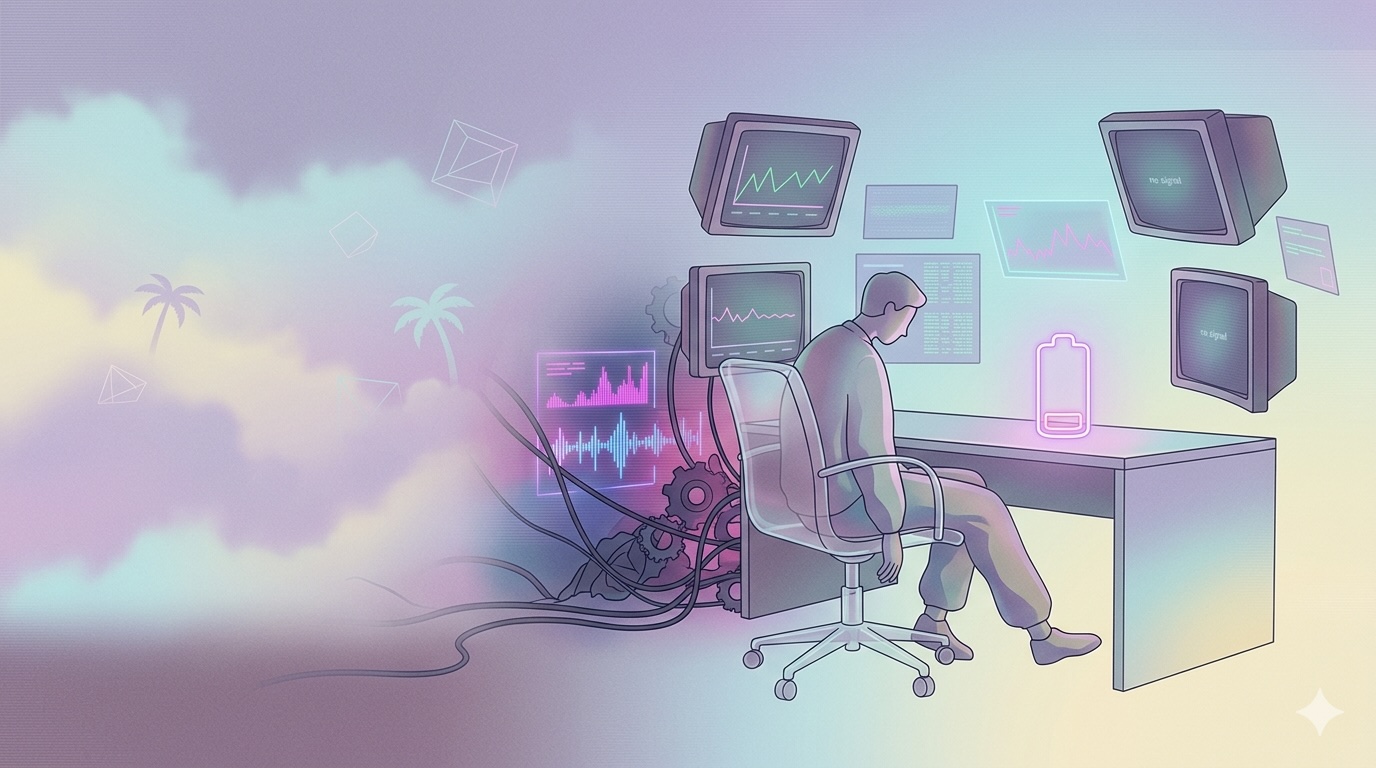
There is a work scene that, from the outside, almost looks enviable: few urgencies, few calls that truly matter, a backlog moving at the geological speed of a mountain, and the vague sense that your contribution could disappear for a week without disturbing the team’s cosmic balance. On paper, it looks like peace. In practice, it is often boreout.
The interesting part is that boreout is usually described badly. Very badly. It gets reduced to a kind of corporate luxury: they pay you and you barely do anything, what exactly are you complaining about? The problem is that work does not just fill a bank account. It also gives structure to time, direction to skills, and at least some friction to our growth. When that friction disappears, well-being does not automatically show up. Sometimes a more elegant form of erosion does.
Not everything that feels heavy is a problem. Sometimes the serious problem is precisely what no longer feels heavy at all.
The opposite of burnout, but not the opposite of suffering 🔄
We learned to recognize burnout because it makes noise: overload, stress, saturation, exhaustion. Boreout is quieter, almost polite. It does not overwhelm you. It empties you out. It grows from a combination of prolonged boredom, lack of challenge, and loss of meaning. In some readings, it also pairs well with the idea of underload: the cognitive load is far below what you could actually handle.
Then there is its less clinical but very eloquent cousin: rust-out. You are not destroyed, you are rusting. Skills you no longer exercise begin to lose sharpness, mental speed drops, confidence gets thinner. It is not a theatrical tragedy. It is silent wear.
The paradox is that you can still end up tired even when work is scarce. Not because you are doing too much, but because you are spending energy trying to remain apparently engaged while internally feeling that you are not growing, not contributing, and in the worst cases, not going anywhere.
Professional boredom is not rest in disguise 🫥
It is worth being honest here: free time imposed by organizational inefficiency is not the same as chosen free time. One afternoon without meetings can be a blessing. Six months in which your role almost never finds a problem worthy of you starts to look more like a slow erosion of professional identity.
Anyone working in software development knows this mechanism well. For better or worse, we are used to measuring value through problems solved, systems improved, ambiguities clarified, small pockets of chaos put back in order. Remove all that, and what remains is a strange suspension: you are formally employed, but you do not feel real movement.
It is the same imbalance that, from the opposite side, can ruin the professional satisfaction I wrote about in Developer happiness. You do not need to live in permanent crisis mode to feel alive. But work does need to push back enough for you to understand that you are truly using judgment, experience, and thought.
The brain does not shut down gratefully when it stops being challenged. More often, it gets bored, distracted, and starts doubting its own value.
When AI agents lower the effort but not the game 🤖
This is where a more recent factor enters the picture, and a far less innocent one than it looks: AI agents. Tools like Copilot and autonomous coding systems are drastically reducing operational effort. Writing boilerplate, implementing linear features, wiring together fairly standard pieces now requires much less friction than it used to. In itself, that is not a problem. Quite the opposite.
The problem begins when the organization keeps defining goals as if that friction still existed. If yesterday a feature required two full days of work and today it takes two hours, the question should not be “great, so how do we fill the rest of the day with emptiness?” It should be: how do we use the freed-up time to raise the level of the work?
If that question never arrives, AI does not remove boreout. It accelerates it. You have less mechanical effort, less execution complexity, less everyday friction. But if responsibility, depth, and expected quality do not grow with that change, the role empties out faster. And for senior profiles the problem is even more visible: you are paid to think, decide, and design trade-offs. Not to passively supervise a keyboard that now runs on its own.
The real problem is not that AI makes some things easier. It is leaving goals designed for a world in which those things were still slow.
At that point two very different scenarios open up. In the healthy one, AI frees time that gets reinvested in architecture, security, quality, observability, and product vision. In the unhealthy one, which is increasingly common, AI accelerates the little work that already exists without changing anything in the decision-making perimeter. The result is less real work, more emptiness, more underload, and a subtle feeling of perceived deskilling. The work becomes less craft-based, less involving, less identity-forming. And that combines perfectly with boreout.
The healthiest response, at least on a personal level, is to move the game to a higher level. If AI takes care of the how, you need to move up toward the why, the what, and the trade-offs. Do not stop at “writing a service.” Define how it should be designed, which constraints it must respect, how it behaves under load, how it protects data, how it is observed in production. In other words: use AI not to do less, but to take on higher-order problems. Because if you get used to supervising lightly and delegating everything, the risk is not only boreout. It is also losing depth, control, and craft.
How boreout actually shows up 🧭
Boreout rarely arrives with a business card. Usually it shows up through signals that seem harmless when taken one by one:
- unusual procrastination even on simple tasks
- stretching trivial activities just to fill the day
- guilt about the small amount of real work being done
- growing irritation toward low-impact activities
- lucid anxiety about your future market value
The critical shift is this: you stop asking whether you like your job and start asking whether it is wearing you down through subtraction. That is an important difference. You are not just bored during an off week. You may be living in a situation where your potential is systematically parked while the organization mostly asks you to appear available.
At that point, many people adopt slightly tragicomic strategies: they stretch short tasks, protect the few interesting assignments as if they were scarce goods, keep work documents open on screen to project operational density. This is not laziness. It is defensive adaptation to a context that no longer knows how to make good use of people’s energy.
The real damage is moral before it is operational ⚙️
Yes, boreout reduces performance, initiative, and innovative capacity. But the most insidious damage is often moral. When your work asks almost nothing meaningful from you, an uncomfortable question can begin to form: if I am not really needed here, how much am I worth outside of here?
That question is dangerous because it mixes two different levels. The first concerns the company: perhaps the context is disorganized, stagnant, unable to distribute work well. The second concerns you: you begin to internalize that poverty of stimulus as if it were a measure of your actual value. That is where boreout stops being just a calendar problem and becomes a self-perception problem.
That is why dismissing it with “enjoy it while it lasts” is elegant nonsense, but nonsense all the same. A light period can be useful. A long period of perceived irrelevance can turn into professional capital decay. And no, that is not melodramatic phrasing: if you stop exercising discernment, technical depth, and the ability to make decisions under constraints, those faculties do not remain unchanged out of nostalgia.
What to do without romanticizing escape 🛠️
The impulsive reaction is understandable: change company immediately, change stack, change life, maybe even change planet if the recruiter is persuasive enough. But fast escape is not always the clearest reading of the situation. The risk is moving from emptiness to chaos without understanding which problem you were actually trying to solve.
A more solid response usually starts with three very concrete checks.
First: understand whether the situation is temporary or structural. One bad quarter is not a diagnosis. A full year of systematic underuse starts telling an organizational truth.
Second: try to create useful work, not ornamental work. Improve documentation, reduce technical debt, propose automations, strengthen security, clarify gray areas in processes. If the environment is recoverable, the first signal often appears in how it reacts to sensible initiative.
Third: measure whether you are still learning anything that will genuinely increase your value in six or twelve months. If the answer is consistently no, then the problem is not vaguely psychological. It is strategic.
This is also where some discipline outside work becomes useful: focused study, well-chosen side projects, exploratory interviews to calibrate the market, and a brutally simple check on your actual energy. Not to live in permanent escape-preparation mode, but to keep stagnation from becoming your new internal standard.
The real question is not “am I doing enough?” but “am I becoming less myself?” 🧠
Boreout is irritating precisely because it touches identity. If you built your craft around impact, learning, construction, and responsibility, being paid to drift does not create serenity. It creates moral friction. You feel unproductive even when it is not your fault, and at the same time you feel complicit in a system that is slowly lowering your threshold for ambition.
That is why the decisive question is not how many tasks you close in a week. It is whether the context you work in is still sharpening your abilities or quietly letting them oxidize in a socially acceptable way.
Healthy work is not the kind that empties you out, nor the kind that anesthetizes you. It is the kind that asks enough of you to leave you more capable than before.
If you recognize yourself in this pattern, there is no need to dramatize it and no need to minimize it either. What helps is looking at the context with precision, removing some shame from the problem, and making lucid decisions before boredom turns into identity. Because the real risk of boreout is not doing too little. It is getting used to a reduced version of yourself and starting to call that normal.